How Often Should You Actually Rotate Sneakers? The Real Answer
Quick Answer: Rotate running or workout sneakers every 1-2 wears rather than daily, giving each pair 24-48 hours to fully decompress its midsole foam between uses. This roughly doubles total shoe lifespan compared to wearing one pair every single day.
‘Buy two pairs and rotate them’ gets repeated constantly without the actual schedule attached — and the schedule is most of what makes rotation work in the first place.

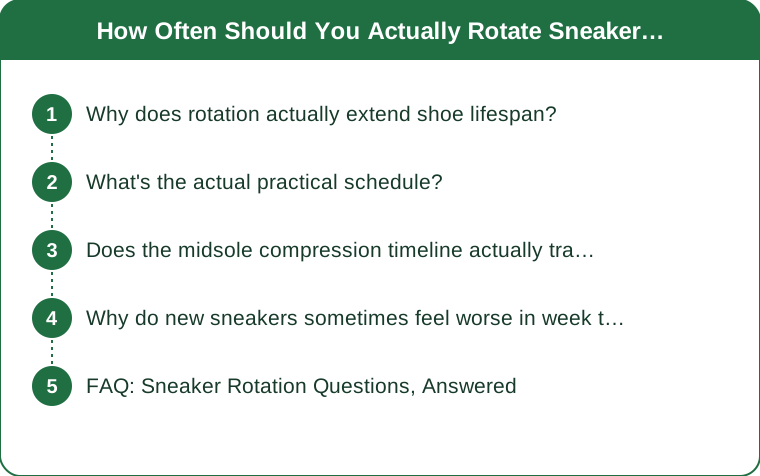
Why does rotation actually extend shoe lifespan?
Midsole foam — the cushioning layer that absorbs impact — doesn’t fully spring back to its original shape immediately after a wear. It needs roughly 24 hours of rest to decompress and recover most of its cushioning properties. Wear the same pair again the next day, and you’re compressing foam that hasn’t fully recovered, which accelerates permanent compression over time.
A rotated pair gets a 2-4 day recovery window between wears instead of 24 hours, which lets the foam bounce back more completely each time — that’s the entire mechanism behind rotation extending total mileage.
What’s the actual practical schedule?
For regular runners or daily gym-goers: alternate every session, not by calendar day — if you work out twice in one day, that’s still one ‘wear’ per pair, then switch. For once-a-day activity, alternating every single day already gives each pair the needed 24+ hour rest.
The real value shows up over weeks and months: a rotated pair used for 300 total miles across two shoes typically shows less midsole compression than one pair pushed to 300 miles alone, because the recovery windows add up.

Does the midsole compression timeline actually track with mileage?
Not perfectly — this is a common misconception. Compression tracks with total loaded hours plus recovery time, not mileage alone. Two pairs with identical mileage but different rotation schedules will show measurably different amounts of permanent compression, because the one that got proper rest cycles retained more of its original bounce.
This is why ‘replace at 300-500 miles’ guidance is a rough average, not a precise number — a well-rotated pair often outlasts that range meaningfully, while a daily-worn pair can compress noticeably before hitting it.
Why do new sneakers sometimes feel worse in week two?
This trips people up mid-rotation: a brand-new shoe’s foam is at its stiffest right out of the box and softens slightly with the first handful of wears as it breaks in. If you’re alternating a new pair with a broken-in one, the contrast can make the new pair feel oddly harsh for the first 1-2 weeks — that’s normal break-in, not a defect, and it resolves as both pairs reach a similar break-in state.
FAQ: Sneaker Rotation Questions, Answered
Do I need identical shoes to rotate, or can they be different models?
Different models work fine and can even be better — alternating between two slightly different cushioning or drop profiles distributes impact stress across slightly different muscle and joint patterns, which some runners find reduces overuse issues.
Does rotation matter for casual, non-workout sneakers?
Less critically — casual shoes see far less repetitive high-impact loading, so the midsole recovery benefit matters less. Rotation there is more about looks and versatility than lifespan.
How do I know when a rotated pair is actually due for replacement?
Check the midsole sides for visible compression lines or an uneven, permanently creased look compared to new — that visual cue is more reliable than a fixed mileage number once you’re rotating.
TL;DR:
- Rotate every 1-2 wears, giving each pair 24-48 hours of foam recovery time
- Recovery time matters as much as total mileage for compression — not mileage alone
- New shoes feeling harsh in week two next to a broken-in pair is normal break-in contrast
- Different models can rotate together and may reduce overuse patterns
The schedule is the actual mechanism — two pairs owned but worn daily each barely gets any of rotation’s real benefit.
Keep Reading
This article is for general informational and styling purposes only. Fit, sizing, and product availability may vary.