The Walking Shoe Expiry: Reading the Signs Your Daily Pair Is Done
Quick Answer: Walking shoes are done at roughly 500–800 km, which for most daily walkers is 6 to 12 months — long before the upper looks worn out. Check three things: compression wrinkles in the midsole foam, a twist test (a dead shoe wrings like a dishrag), and a thumb press into the midsole (springy = alive, dented = gone). New aches on unchanged routes almost always mean old shoes.
Running shoes come with replacement rules. Everyone knows the mileage number, everyone has an opinion about it.
Walking shoes do equal daily duty at a fraction of the drama, and so they die completely unnoticed — cushioning long dead underneath an upper that still looks perfectly fine.
Then one day your knees start filing complaints about a route you’ve walked for two years, and nobody connects the two.
Here’s how to catch it earlier.

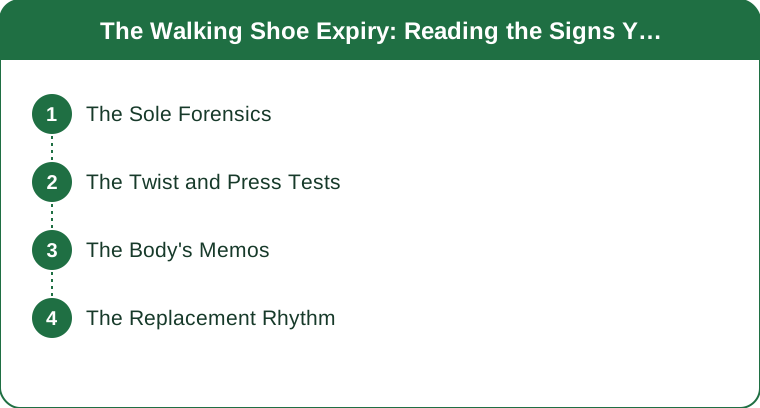
What Do the Soles Tell You?
Flip the pair over. The sole is testimony; the upper is marketing.
Tread worn smooth at the heel-strike zone (usually the outer rear corner) and at the push-off zone (under the ball of the foot and big toe) is the visible clock. When the pattern has gone flat and shiny in those two places, traction is gone — and traction loss on a wet pavement is the failure mode that actually hurts you.
Uneven wear narrates your gait. One outer edge bald means you’re supinating; heavy inner wear means the opposite. Worth knowing, and worth mentioning to a physio if it’s dramatic.
Now look at the midsole sidewall — the foam layer between the tread and the upper. Fine horizontal compression wrinkles running along it are the cushioning’s death certificate. That foam has been compressed a few million times and has stopped springing back.
This is the sign people miss most, because it requires looking at the side of the shoe rather than the top.
The Two-Second Tests
No mileage log required.
The twist test. Hold the heel in one hand and the toe in the other, and wring gently, like a towel. A supportive shoe resists — you’ll feel the structure fighting you. A finished shoe twists like a dishrag. That torsional stiffness is a real part of how a shoe supports your foot, and when it’s gone, it’s gone.
The press test. Push your thumb into the midsole foam. Springy pushback means alive. A dent that stays, memory-foam style, means deceased.
The flat-surface check. Set both shoes on a table and look at them from behind at eye level. If either leans noticeably inward or outward, the midsole has collapsed on one side and the shoe is now actively pushing your ankle out of alignment.

What Signals Come From Your Body?
The subtler memos, and they arrive before you’d think to check the shoes.
- New foot fatigue on a standard walk. The same 5 km that felt fine now leaves your feet aching.
- Arch grumbles, especially in the first steps of the morning.
- Shin and knee whispers on unchanged routines. Same route, same distance, same pace, new complaints.
The rule that saves people money and physio appointments: new aches plus old shoes = replace the shoes first. Do that before you start investigating your body, changing your route, or buying an insole to fix a problem that a £70 pair of shoes created.
It’s not a guaranteed fix, but it’s the cheapest first move by a distance, and it’s right more often than not.

How Often Should You Replace Walking Shoes?
Roughly 500–800 km, the same window as running shoes — walking is lower-impact per step, but you take a lot more steps and they’re worn a lot more hours.
Translating that into real life:
| Daily walking | Approx. replacement |
|---|---|
| 3,000–5,000 steps | 12–18 months |
| 8,000 steps | 9–12 months |
| 12,000+ steps | 6–8 months |
Heavier walkers, hot climates, and rough surfaces all shorten it.
Three habits that make this easy:
Write the purchase month inside the tongue in permanent marker. Future-you genuinely will not remember, and “sometime last year” is not a date.
Rotate two pairs. Alternating lets the foam decompress fully between wears, and two pairs rotated outlast three pairs worn sequentially. This is the single best-value trick in the article.
Give the retired pair a second career. Gardening, taking the bins out, errands under a kilometer. A dead walking shoe is still a perfectly good shoe for standing in.
Frequently Asked Questions
Do walking shoes expire if you don’t wear them?
Yes, slowly. Midsole foams — especially EVA — oxidize and stiffen over time, and polyurethane midsoles can crumble outright after several years. A pair that’s sat in a box for five years may be past it before its first walk. Buying two pairs on sale to use over 18 months is fine; stockpiling for a decade isn’t.
Can you replace just the insole instead?
A fresh insole makes an old shoe feel noticeably better for a week or two, and it’s a legitimate thing to do on a shoe that’s still structurally sound. But it doesn’t restore the midsole, which is where the actual cushioning and support live — if the twist and press tests fail, an insole is a plaster on a structural problem.
Are expensive walking shoes worth it?
Up to a point. The meaningful differences are midsole quality, fit, and construction, and those tend to plateau in the mid price range rather than at the top of it. Fit matters more than price: a well-fitting mid-price shoe beats a poorly-fitting premium one every time. If you have persistent foot pain, plantar fasciitis, diabetes, or a diagnosed gait issue, see a podiatrist — shoe choice under those conditions is a medical decision, not a shopping one.
TL;DR:
- 500–800 km, or roughly 6–12 months for most daily walkers.
- Check the midsole sidewall for compression wrinkles — the sign nearly everyone misses.
- Twist test: a dead shoe wrings like a dishrag. Press test: dents that stay mean gone.
- New aches on unchanged routes? Replace the shoes before investigating your body.
- Write the purchase month inside the tongue.
- Rotate two pairs — they outlast three worn one after another.
Keep Reading
This article is for general informational and styling purposes only. Fit, sizing, and product availability may vary.