Why Brand-New Running Sneakers Can Feel Worse in Week Two Than They Did on Day One
Quick Answer: Midsole foam sits compressed in a box for weeks or months before you buy it, which makes it feel artificially soft on day one. Over the first one to two weeks of regular running, it settles into its true, firmer engineered density. That’s normal break-in, not premature wear — so don’t judge a shoe’s real cushioning until you’ve put roughly 30–50 miles on it.
You buy new running shoes. Day one, they feel like clouds. You tell people about it.
Two weeks later the same pair feels noticeably firmer, and you start wondering whether you got a bad batch or whether the cushioning is already gone.
Neither. What you’re feeling is the shoe finishing a process that started before you ever tried it on.
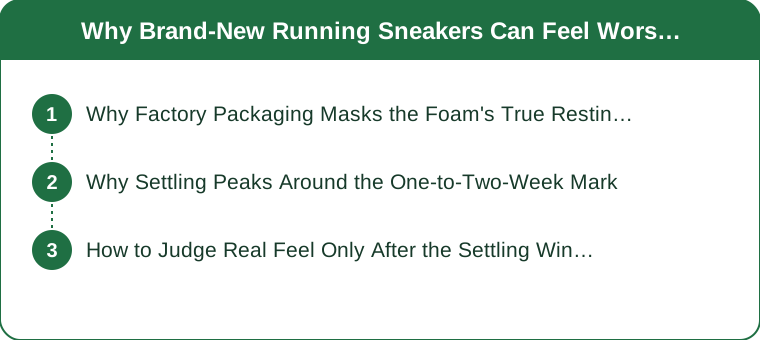
Why Do New Running Shoes Feel Softer Than They Really Are?
Because of how they got to you.
Midsole foams — EVA, TPU, PEBA-based supercritical foams, all of them — are made of gas-filled cells in a polymer matrix. Their feel depends on the state of those cells: how expanded they are, how the matrix has settled, how recently the material was processed.
A running shoe typically spends weeks to months boxed, stacked, and shipped before it reaches a store shelf, and more time after that. During all of it, the midsole sits under mild static compression, packed alongside dozens of identical boxes.
That storage leaves the foam in a slightly compressed, temporarily soft state. The plushness you feel on day one is partly a storage artefact, not the cushioning level the shoe was engineered to deliver.
There’s a second factor: your feet haven’t adapted yet. A new shoe changes your stack height, heel drop, and rocker geometry, and everything feels novel for the first few runs. Novelty gets read as softness surprisingly often.
Why Does the Change Peak at One to Two Weeks?
The foam’s transition into its true resting density is driven by loading. Each footstrike compresses and releases the cells, and over repeated cycles the material settles into the state it will hold for most of its life.
That process largely completes within roughly the first one to two weeks of regular running, or about 30 to 50 miles for most people. If you run three or four times a week, that’s exactly when you notice the change — which is why the “week two” complaint is so consistent across brands and models.
What you’re feeling at that point is not degradation. It’s the shoe arriving at its designed specification.
Actual foam degradation is a much slower and different story. It happens over hundreds of miles as the cell structure permanently breaks down, and it shows up differently — the shoe feels dead and flat rather than firm and responsive, and creases in the midsole stop springing back.

How Should You Judge a New Running Shoe?
Give it 30–50 miles before deciding. Two weeks of regular running. Judge the settled shoe, not the packaged one.
This has a practical consequence worth knowing: a shoe that feels merely “fine” on day one may be the better long-term choice than one that feels incredible. The plush one might be soft because of storage, and it will firm up. The fine one is closer to its true state already.
Here’s how to run the trial properly:
- Alternate with your current shoes for the first two weeks. This gives the foam recovery time between runs and gives you a direct comparison.
- Keep the first few runs short and easy. Three to five miles. Your feet and calves are adapting to new geometry, and a long run in unfamiliar shoes is how calf strains happen.
- Take notes after each run. Feel changes gradually enough that memory is unreliable — write one line down.
- Check the return window before you start. Many retailers offer 30–90 day trial returns on running shoes specifically because of this. Know your deadline.
What should worry you in week one: hotspots, blisters, numbness, arch pain, or a pinched toe box. Those are fit problems, and fit does not break in. Foam settles; the shape of the shoe does not meaningfully change. Return those immediately rather than hoping.
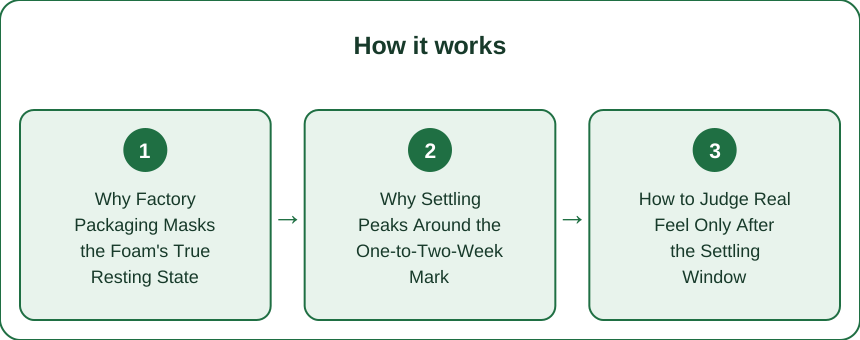
Myth vs Fact: Breaking In Running Shoes
Myth: You need to break in running shoes over many miles. Fact: Modern running shoes should be comfortable from the first wear. What changes is the foam’s density, not the fit. If they hurt on day one, they’ll hurt on day fifty.
Myth: Firmer means the cushioning is worn out. Fact: In week two, firmer means settled. Worn-out foam feels dead and unresponsive rather than firm and springy, and it takes hundreds of miles.
Myth: Wearing them around the house breaks them in. Fact: Walking loads the midsole far less than running does. Useful for checking fit, not for settling foam.
Myth: Rotating shoes is just for gear enthusiasts. Fact: Foam needs roughly 24–48 hours to fully rebound between runs. Rotating two pairs lets each recover, and there’s evidence it extends the usable life of both.
Myth: More expensive foam doesn’t do this. Fact: All foams settle. Newer supercritical foams may recover better between runs, but they still arrive compressed from storage and still find their true density with use.
FAQ
How many miles do running shoes actually last?
Commonly quoted as 300–500 miles, but it varies widely with foam type, your weight, running surface, and gait. Track total mileage per pair rather than guessing by appearance — outsoles often look fine long after the midsole has given up.
Should I buy the same model I already like?
Be aware that brands revise models annually and the foam or geometry can change substantially between versions. A “v12” is not guaranteed to feel like the “v11” you loved, so treat it as a new shoe and run the same two-week trial.
Can I speed up the break-in?
Not usefully, and there’s no need. The settling happens through running, and forcing it — bending, heating, prolonged wear — risks damaging the midsole rather than maturing it. Just run in them normally.
TL;DR:
- Midsole foam arrives compressed and artificially soft from weeks in a box
- The plush day-one feel is partly a storage artefact, not the designed cushioning
- Foam settles into its true density in the first 1–2 weeks, roughly 30–50 miles
- Firmer at week two is normal break-in, not premature wear
- Judge cushioning after 30–50 miles; keep early runs short and alternate pairs
- Fit problems — hotspots, blisters, numbness — never break in; return those immediately
Keep Reading
This article is for general informational and styling purposes only. Fit, sizing, and product availability may vary.