Why Sneaker Insoles Wear Out Before the Shoe Does
Quick Answer: The insole is a thin piece of low-density foam that takes your full body weight on every step and gets no recovery time inside a warm, damp shoe. It compresses permanently in roughly 100–200 miles, long before the midsole or outsole show meaningful wear. If your shoes feel dead but the tread looks fine, the insole is the most likely culprit and a replacement costs a fraction of new shoes.
The shoes look fine. The tread is intact, the upper is clean, nothing is coming apart. They just do not feel like anything anymore.

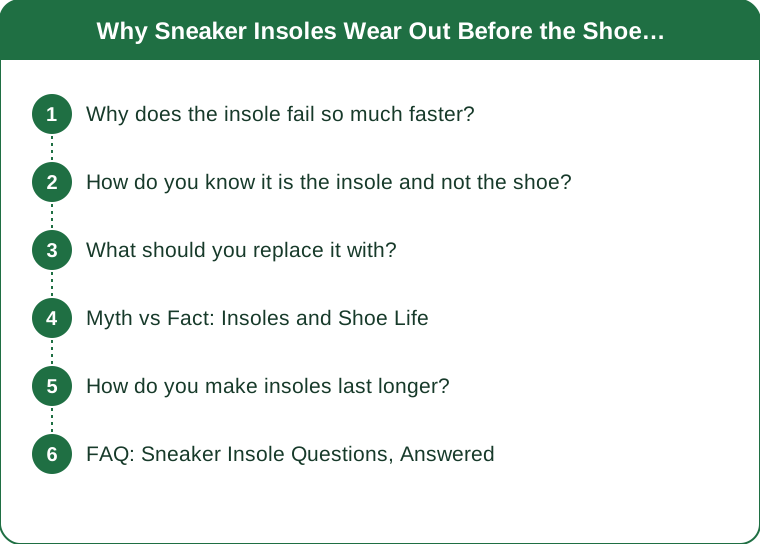
Why does the insole fail so much faster?
It is the thinnest, softest, least protected component in the whole shoe.
Most factory insoles are open-cell foam — usually a thin layer of EVA or polyurethane, sometimes with a fabric top. Open-cell foam compresses easily, which is why it feels nice initially, and it recovers poorly, which is why it stops feeling nice.
Compare that to the midsole. The midsole is thick, dense, closed-cell foam engineered specifically for repeated compression and recovery, and manufacturers rate it for hundreds of miles. The outsole is rubber. Both are designed to last. The insole often is not designed at all in any serious sense; it is there so the inside of the shoe feels finished.
Then add the environment. The inside of a shoe is warm and humid, and heat plus moisture accelerates the breakdown of foam considerably. The insole sits in the worst conditions in the shoe, made of the least durable material, taking the most direct load.
The timeline that follows is fairly consistent: noticeable flattening around 100–200 miles of walking, which for many people is two to four months of ordinary daily wear. Running shoe midsoles are typically rated 300–500 miles. The insole is done at somewhere between a quarter and half the life of the shoe around it.
How do you know it is the insole and not the shoe?
Take it out and look at it. This takes ten seconds and answers the question completely.
Pull the insole out and set it on a flat table.
- Does it lie flat, or does it hold a permanent bowl shape under the heel? A dished heel means the foam has taken a compression set and will not come back.
- Press your thumb into the heel area. Fresh foam pushes back and rebounds immediately. Dead foam feels dense, thin, and stays dented for a second.
- Compare thickness heel to midfoot. A worn insole is visibly thinner at the heel and under the ball of the foot, which are the two loading points.
- Look at the top fabric. Worn through to the foam at the heel or under the big toe is a clear signal, though the foam can be dead while the fabric still looks intact.
Then check the shoe itself. Press hard into the midsole from the outside with your thumb — it should compress and spring back. Look at the outsole tread for genuine wear-through, and set the shoes on a table at eye level to check whether they lean inward or outward, which indicates midsole collapse.
If the insole is dished and the midsole still springs, you have a ten-dollar problem, not a hundred-and-forty-dollar one. That is the single most useful diagnostic in this whole article.
What should you replace it with?
Something with a denser foam than the one that failed, matched to the shoe’s actual volume.
Match the volume first. A replacement insole that is thicker than the original changes the fit — a snug shoe becomes tight, and your heel can sit higher and slip more. Take the old insole with you and compare thickness, or buy trim-to-fit and use the old one as a template.
Look for closed-cell foam or a dual-density build. Open-cell foam that feels plush in the store will fail on the same timeline as the one you just removed. Denser feels less exciting on the shop floor and lasts several times longer.
Cushioning is not the same as support. A cushioned insole adds shock absorption. A supportive one has structure — a firmer heel cup and some arch shape — and holds the foot’s position. If your issue is that the shoes feel dead, you want cushioning. If your issue is arch or heel pain, that is a different purchase and worth a conversation with a professional. Persistent foot pain deserves an actual assessment rather than an internet insole. This is general information, not medical advice.
Skip gel inserts for everyday walking. They feel remarkable pressing them with a thumb and tend to bottom out under real load, and they add weight.
Rotate two pairs of insoles if you wear the shoes daily. Foam recovers substantially given twenty-four hours out of a warm shoe, and alternating extends the life of both sets meaningfully.

Myth vs Fact: Insoles and Shoe Life
Myth: If the tread looks fine, the shoes are fine. Fact: Outsole rubber routinely outlives every cushioning component in the shoe. Tread is the last thing to go and the least useful indicator. Plenty of shoes with perfect tread have nothing left inside them.
Myth: A new insole makes old shoes as good as new. Fact: It helps enormously if the midsole is still intact, and it does nothing if the midsole has collapsed. Run the thumb-press test on the midsole before you buy anything — that is what decides whether the shoe is worth saving.
Myth: More cushioning is always better. Fact: Excessive soft cushioning reduces stability and can make your foot work harder to stay balanced. It also compresses faster, precisely because softer foam takes a set sooner. The most comfortable insole in the store is frequently the one that will feel dead in six weeks.
Myth: Insoles cause blisters. Fact: Wrong-sized insoles cause blisters, usually because a thicker replacement changed heel fit and introduced slippage. A correctly matched insole reduces friction because the foot stops sliding around on a flattened surface.
Myth: You should replace insoles on a fixed schedule. Fact: Mileage varies enormously with body weight, gait, and surface. Check by inspection every couple of months rather than by calendar. The flat-table test takes ten seconds and beats any generic interval.
How do you make insoles last longer?
Almost all of it is about drying and rotating.
Take the insoles out after any sweaty wear. This is the single highest-value habit and it costs five seconds. Foam left damp in a closed shoe overnight degrades much faster and holds odor permanently. Pulling them out lets both the insole and the shoe dry properly.
Rotate two pairs of shoes. Foam is viscoelastic — it recovers over hours, not seconds. A shoe that gets a full day off between wears keeps its cushioning meaningfully longer than one worn daily. This applies to the midsole as well as the insole.
Never machine wash or machine dry them. Heat destroys foam structure, and a tumble dryer will kill an insole in one cycle. Hand wash with mild soap in cool water, press out the moisture in a towel, and air dry away from direct heat.
Keep them out of hot cars. A closed car in late summer easily exceeds temperatures that permanently soften and deform foam. Gym shoes living in a trunk age much faster than gym shoes living in a closet.
Weigh the shoe against your actual use. If you are on your feet all day on concrete, no insole is going to last four months, and planning to replace them twice a year is realistic rather than pessimistic.
And buy the replacement before you need it. The window where the insole is dead but the shoe is fine is the window where people give up and buy new shoes. Having a spare pair in the closet is what makes the cheap fix the one you actually take.
FAQ: Sneaker Insole Questions, Answered
Can I use insoles from an old pair in a new shoe?
Only if the old ones still pass the flat-table test, which they usually will not if the shoe they came from is retired. Shape also matters — insoles are cut to a specific last, and a mismatched one will bunch or leave gaps at the edges.
Why does only one insole wear out faster?
Most people load one side more than the other, from a leg length difference, an old injury, or just habit. This is extremely common and mostly not a problem in itself. If the difference is dramatic, or if it comes with pain on one side, it is worth mentioning to a physical therapist or podiatrist.
Do expensive shoes come with better insoles?
Often only marginally. Plenty of premium running shoes ship with a basic foam insole because the brand expects serious users to swap in their own. The money in an expensive shoe usually goes into the midsole and upper, which is arguably the right place for it — those are the parts you cannot replace.
TL;DR:
- Insoles are thin open-cell foam in a warm damp environment, so they flatten in 100–200 miles
- Midsoles and outsoles routinely last two to four times longer, which is why dead-feeling shoes often look fine
- Pull the insole out and set it on a table: a dished heel means replace the insole, not the shoe
- Take them out to dry after sweaty wear, rotate two pairs, and never put them in a dryer
The test takes ten seconds and the fix costs about a tenth of new shoes. It is genuinely surprising how many pairs get retired with several hundred good miles still in them.
Keep Reading
This article is for general informational and styling purposes only. Fit, sizing, and product availability may vary.