Why Your Sneakers Feel Different on Cold Mornings
Quick Answer: Foam midsoles get significantly firmer in cold temperatures — modern supercritical foams can lose a meaningful share of their cushioning below about 5°C. Rubber outsoles also harden and lose grip. The practical responses are to store shoes indoors rather than in a car or porch, allow 10 minutes of walking before judging them, and accept that winter is not the season to test a new pair.
You put on the same shoes you have worn all year and they feel like different shoes. Harder underfoot, less bouncy, slightly dead.
By the afternoon they are fine again.
Midsole foam is a temperature-sensitive material, and the newer and more advanced the foam, the more sensitive it tends to be.

What happens to the midsole in the cold?
It stiffens, and the effect is larger than most runners expect.
Midsole foams — EVA, TPU, and the newer supercritical PEBA-based foams — are polymers, and polymer stiffness rises as temperature falls. Below a certain point they behave less like a spring and more like a solid.
Testing consistently shows measurable cushioning loss in cold conditions, and the effect is most pronounced in the highly responsive foams used in modern performance shoes. The materials that give the best energy return at room temperature are frequently the ones most affected by cold.
A shoe left in a car overnight is at ambient temperature — potentially below freezing — and takes real time to warm up once you start moving.
This is why the shoe feels normal by mile two. Body heat and repeated compression warm the foam, and its properties return.
Does the outsole change too?
Yes, and this one has a safety consequence.
Rubber hardens as it cools, and harder rubber has less grip. It deforms less over surface texture, reducing the contact area that produces friction.
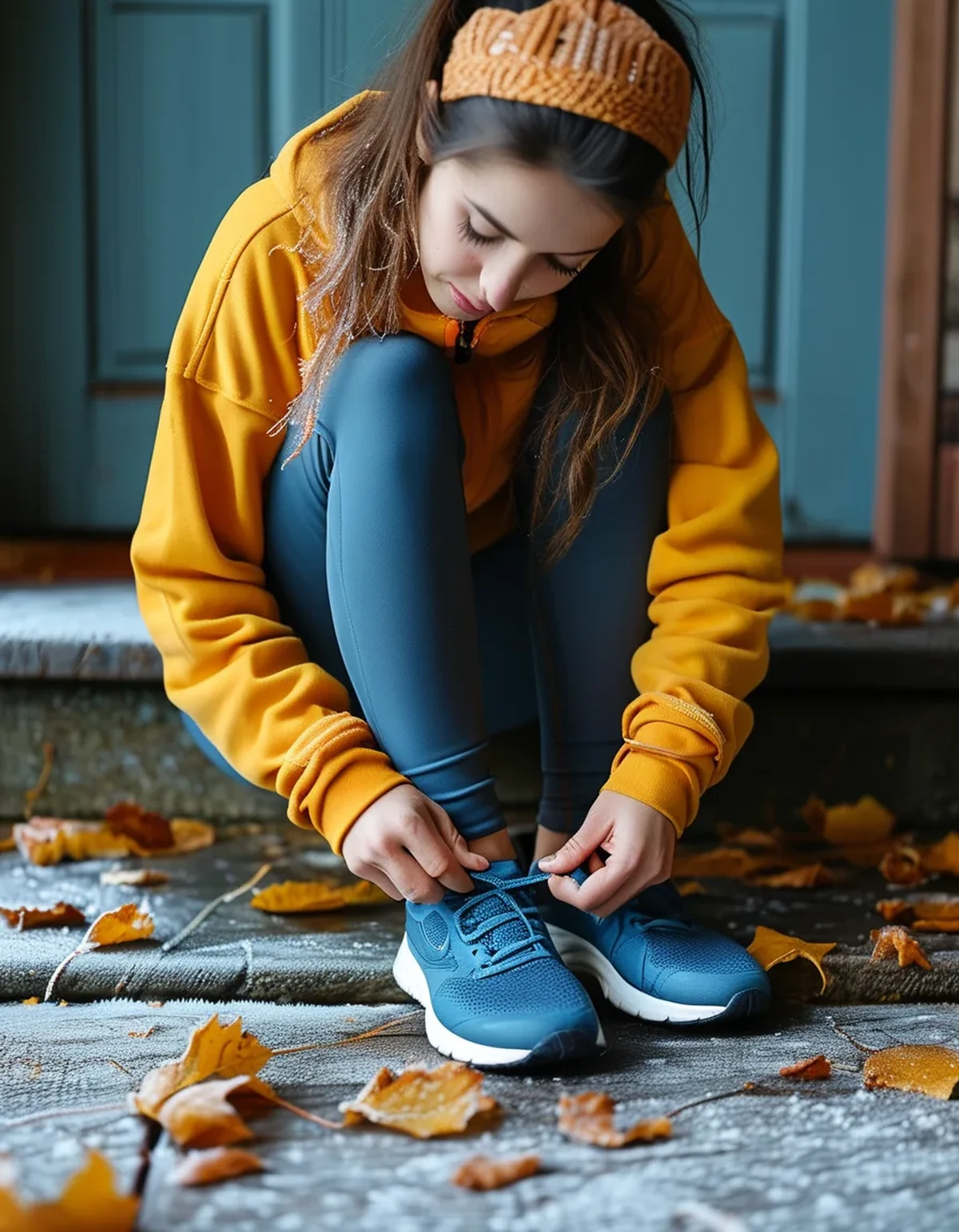
Combined with autumn conditions — wet leaves, damp pavement, early frost — the grip you have on a cold morning is meaningfully less than the grip the same shoes gave in summer.
Softer rubber compounds are affected more, which is the frustrating part: the grippiest summer outsoles lose the most proportionally.
Practical response: shorten your stride slightly on cold wet surfaces, be conservative on the first few minutes, and treat painted lines, metal covers and wet leaves as genuinely slippery. If you run through real winter, a shoe with a winter-rated compound or small studs is a different category of grip and worth having.
Does this mean cold weather damages the shoe?
No — the effect is temporary and fully reversible.
Cold stiffening is a physical, reversible change in the polymer. Nothing degrades, and the shoe performs normally once warm.
What does damage shoes is repeated hard drying. Putting wet shoes on a radiator or using a hot dryer degrades the foam and the adhesives permanently. Stuff them with newspaper and dry them at room temperature, away from direct heat — this is by far the most common way winter kills a pair of shoes.
Salt is the other winter hazard, in areas that grit roads. It leaves residue that degrades uppers and adhesives, and it should be wiped off rather than left to dry in.
Storing them in the cold is not harmful in itself. It is just inconvenient, since you start every run on cold foam.
What should I actually do about it?
Four things, all simple.
Store them indoors. Not the car, not the porch, not the garage. Shoes at room temperature start the run already at working temperature, and this is the whole fix for most people.
Walk for ten minutes before judging them, or run the first kilometre easy. A cold shoe genuinely is a different shoe, and adjusting your stride to compensate means adjusting it wrongly once it warms.
Do not test a new pair in cold weather. A shoe evaluated on a 2°C morning will feel harsher than the same shoe in spring, and people return shoes that were fine. Judge new shoes indoors first, or accept the caveat.
Rotate two pairs in winter. Not for the foam properties but for drying — a wet shoe takes 24 hours or more to dry properly at room temperature, and running in a damp shoe is bad for the shoe and worse for your feet.
And check the tread more often. Cold, wet, gritty conditions wear outsoles faster than dry summer running.
Myth vs Fact: Sneakers in Cold Weather
Myth: cold weather permanently ruins the cushioning. Fact: the stiffening is fully reversible. What ruins cushioning is heat — radiators, dryers, hot cars in summer.
Myth: you should size up for thicker winter socks. Fact: usually not. Most running shoes have enough volume, and a shoe that is too large causes movement and blisters. If you genuinely need thicker socks, check the lacing before changing the size.
Myth: expensive foams are less affected. Fact: often the reverse. The highly responsive supercritical foams tend to be more temperature-sensitive than basic EVA, so premium racing shoes can be the worst offenders on a cold morning.
Myth: the shoe feels dead because it is worn out. Fact: check it in a warm room before concluding anything. Midsole death and cold stiffness feel very similar and one of them resolves by itself.
Myth: waterproof shoes are better for winter running. Fact: they keep rain out and they keep sweat in, and once water gets in over the collar it stays. For most runners a breathable shoe with wool socks dries faster and works better — waterproofing suits walking more than running.
FAQ: Cold Weather Sneaker Questions, Answered
At what temperature does this become noticeable?
Most people start noticing around 5 to 10°C, and it becomes obvious below freezing. It varies with the foam — a simple EVA midsole changes less dramatically than a modern supercritical foam, which is one genuine argument for a basic trainer as a winter shoe.
How long does it take to warm up during a run?
Roughly 10 to 15 minutes of running for a shoe stored at room temperature, and considerably longer for one that started at freezing. This is the practical argument for indoor storage — you spend the first portion of every run on foam that is not working properly.
Should I have a separate winter shoe?
If you run outdoors through real winter, it is worth it — more for the outsole than for the midsole. A winter-compound or lightly studded outsole transforms grip on cold wet surfaces, and it also protects your good shoes from salt and repeated soaking. For occasional cold-weather running, indoor storage and a bit of caution covers it.
TL;DR:
- Foam midsoles stiffen significantly in the cold, and the most responsive modern foams are often the most affected — the shoe genuinely is different.
- Rubber outsoles harden and lose grip too, which combined with wet leaves and frost is the safety-relevant part.
- Store shoes indoors, and give them 10 to 15 minutes before judging how they feel.
- The stiffening is fully reversible; heat damage is not. Never dry wet shoes on a radiator — newspaper and room temperature.
Do not evaluate a new pair on a cold morning. Plenty of good shoes get returned for feeling harsh when the real problem was that they were 2°C.
Keep Reading
This article is for general informational and styling purposes only. Fit, sizing, and product availability may vary.