The Right Workout Shoes: Why One Pair Cannot Do Everything
Somewhere in most closets lives one heroic pair of sneakers doing every job: the run, the lift, the class, the errands. Here is the problem your knees have been trying to report: athletic shoes are specialized equipment, engineered with opposite priorities — the cushioning that protects a run actively sabotages a squat — and the wrong shoe for the job is a quiet contributor to everything from shin splints to wobbly lifts. The fix is a small, strategic shoe wardrobe. Here is the matching guide.

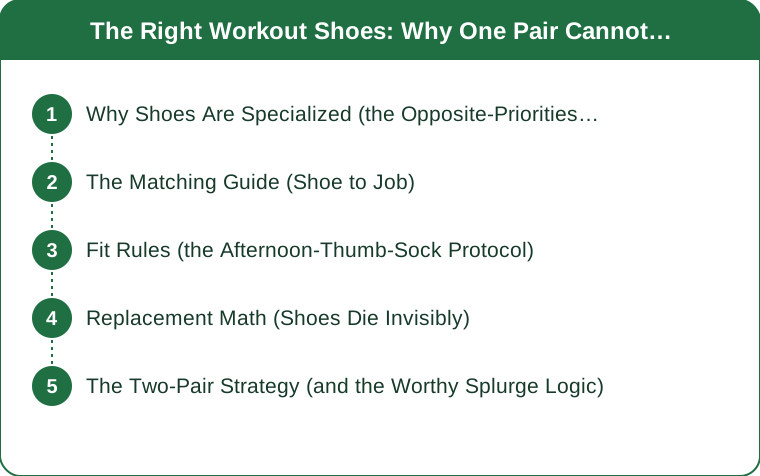
Why Shoes Are Specialized (the Opposite-Priorities Problem)
The engineering conflict, illustrated: running shoes maximize cushioning and forward-rolling geometry — soft foam stacks absorbing repeated impact, built exclusively for straight-ahead motion; lifting wants the exact opposite — a firm, stable platform where force transfers to the floor without squishing (squatting on running-shoe foam is squatting on a mattress: unstable, power-leaking, ankle-wobbling); court and class sports demand a third thing entirely — lateral support for side-to-side cutting that running shoes, with zero lateral engineering, handle so poorly that ankle rolls in them are a cliché. No shoe can hold all three priorities. That is not marketing. That is geometry.
The Matching Guide (Shoe to Job)
The assignments: running (roads and treadmills — genuine running shoes, fitted at a running store if possible; the added mileage-and-gait matching is free injury insurance), lifting and strength training (flat, firm-soled shoes — dedicated trainers, cross-trainers, lifting shoes, or the barefoot-adjacent minimalist route; even classic flat canvas sneakers out-squat premium runners), HIIT and studio classes (cross-trainers — the deliberately versatile middle: moderate cushion plus lateral support; the correct single shoe if you truly must own only one), court sports including the pickleball boom (court shoes, non-negotiably — lateral construction is the entire product), and walking and life (the retired running shoe’s honorable second career — mileage-dead for running, perfect for errands). Two well-chosen pairs cover most women’s actual weeks: a runner and a trainer.

Fit Rules (the Afternoon-Thumb-Sock Protocol)
The fitting science: shop in the afternoon (feet swell through the day — morning-fitted shoes pinch by evening), wear the actual socks of the activity, demand a thumb-width of space at the toe (running feet slide and swell forward; the too-small running shoe is the number-one cause of the black-toenail merit badge nobody wanted), respect your width (many brands ship wide options — the squeezed-pinky compromise ends bunion-adjacent), and test the movement of the sport in the store: squat in trainers, jog in runners, cut side-to-side in court shoes — a store that discourages this is a store selling shoes for standing. Comfort at minute one is the standard; break-in mythology mostly excuses bad fit. The right shoe feels right immediately.
Replacement Math (Shoes Die Invisibly)
The expiration briefing: running-shoe cushioning dies at roughly 500–800 kilometers — invisibly, from the inside, long before the upper looks worn (the tread can look fine while the foam beneath has compressed into a memory of itself), and the classic symptom of dead shoes is not the shoe but the body: new shin, knee or foot complaints on unchanged mileage are a replace-the-shoes flag before a see-the-doctor flag. Tracking hacks: write the purchase date inside the tongue, or let a running app tally shoe mileage automatically. Trainers and court shoes die by support-feel and tread instead — the lean test (set the shoe on a table; a visible sideways lean means broken-down midsole) and smooth-worn tread are the tells. Rotation extends everything: two pairs alternated outlast three pairs run sequentially, because foam decompresses between wears. Shoes are consumables with a service life. Budget accordingly.
The Two-Pair Strategy (and the Worthy Splurge Logic)
The practical wardrobe: for most active women — one true running shoe (if you run at all; this is the splurge slot: $100–140 buys legitimate engineering, and the injury-prevention math forgives the price) plus one cross-trainer for everything else ($70–100), with court shoes joining only if racket-and-paddle sports do, and the retired-runner rotation handling life mileage for free. Where budget shoes genuinely suffice: lifting (flatness is cheap — the $40 flat sneaker squats beautifully) and walking. Where they do not: running mileage (the podiatry bill of worn or wrong shoes always exceeds the sale-rack savings). The organizing principle, one final time: match the shoe to the forces of the job — cushion for impact, flatness for force, lateral for cutting — and your joints, the silent stakeholders in every purchase, will file no further complaints.
Workout shoes, decoded: runners for running, flat and firm for lifting, lateral support for anything with side-steps, replaced on mileage rather than appearance, and fitted in the afternoon with a thumb of toe room. Two smart pairs cover the week; the one-heroic-sneaker era ends here. Your knees have been drafting this thank-you note for years.
Keep Reading
This article is for general informational and styling purposes only. Fit, sizing, and product availability may vary.